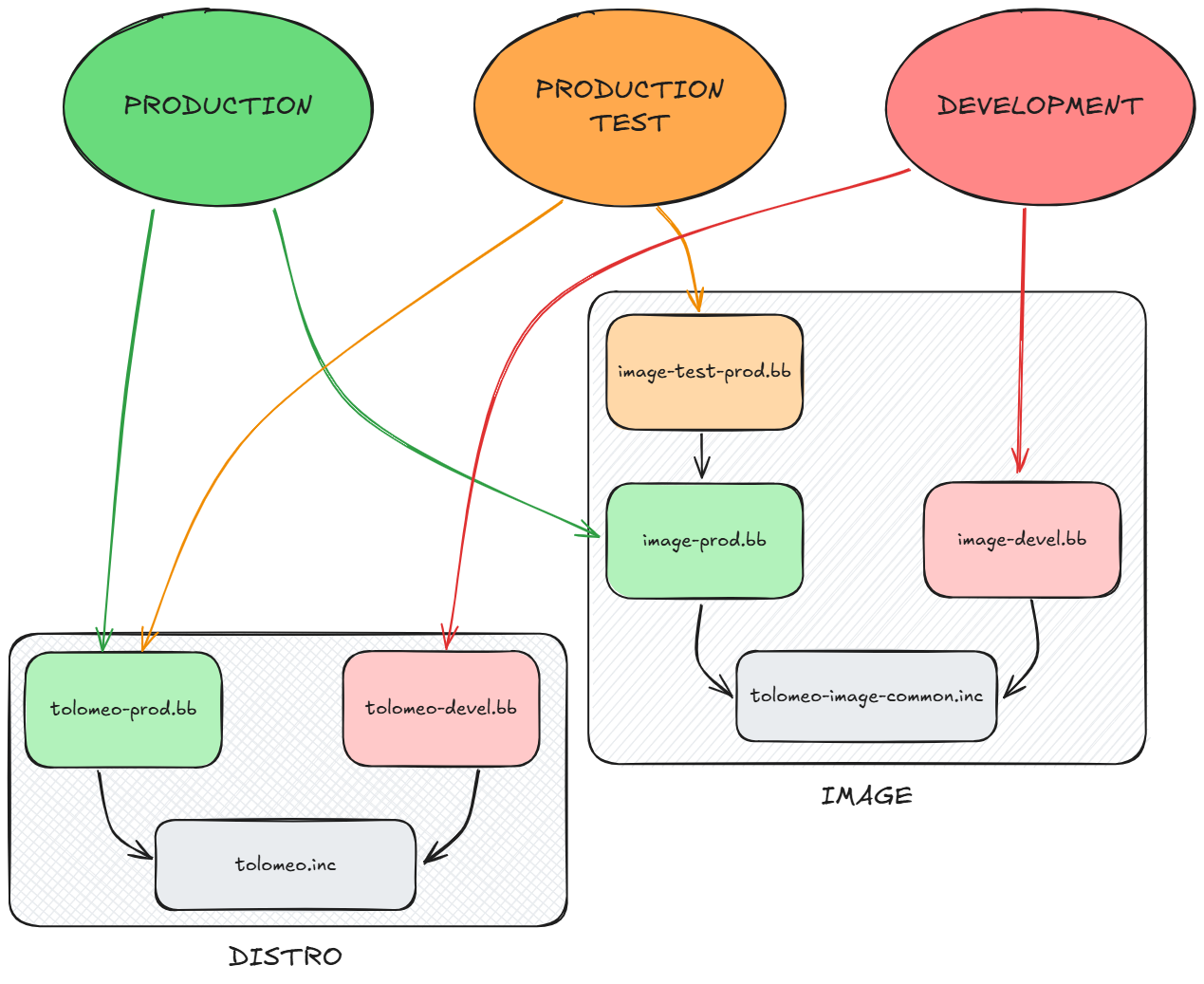
Architecture Overview
This document provides a comprehensive overview of the ToloMEO Edge Platform architecture, including system components, security features, and operational workflows.
Table of Contents
System Architecture
Platform Overview
ToloMEO is a secure edge computing platform designed for industrial IoT applications with the following core principles:
- Security First: Hardware-backed security with secure boot and encrypted storage
- Reliable Updates: A/B partitioning with automatic rollback capabilities
- Real-time Monitoring: Comprehensive system and application monitoring
- Container Ready: Docker-based application deployment and management
Target Platforms
| Platform | Status | Use Case |
|---|---|---|
| NXP i.MX8M Plus | Primary | Production hardware deployment |
| x86-64 QEMU | Development | Development and testing |
Layer Structure
meta-tolomeo-app
Purpose: Application and service definitions
Key Components:
- ToloMEO Manager: Web-based management interface
- Flask backend (
tlm-manager-be) - Flutter frontend (
tlm-manager-fe) -
API documentation (
tlm-manager-docs) -
System Monitoring: Performance and health tracking
-
Glances system monitor
-
OTA Services: Update management and monitoring
- Update notification system (
ota-monitor) -
Post-boot validation (
ota-postboot) -
Security Tools: Compliance and auditing
- Lynis security scanner
- Kernel hardening checker
meta-tolomeo-distro
Purpose: Distribution configurations and system integration
Key Components:
- Distribution Definitions:
tolomeo-prod: Production with security hardening-
tolomeo-devel: Development with debugging tools -
System Services:
- Certificate mounting (
certs-mount) - Shared folder mounting (
shared-mount) -
SWUpdate configuration
-
Security Configuration:
- Hardening flags and policies
- Integrity checking setup
- Audit framework configuration
meta-tolomeo-nxp
Purpose: NXP i.MX hardware support
Key Components:
- Secure Boot: Signed bootloader and kernel images
- Hardware Drivers: i.MX8M Plus specific drivers
- Board Support: Hardware-specific configurations
- Cryptographic Tools: NXP CST integration for signing
meta-tolomeo-qemu
Purpose: QEMU virtualization support
Key Components:
- Virtual Machine Configuration: x86-64 QEMU setup
- Development Features:
- VirtIO device support
- Shared folder mounting
- Overlay disk configuration
- Testing Infrastructure: Automated testing support
Build Configurations
Configuration Structure
All kas configuration files follow this naming pattern:
Available Builds
| Configuration | Machine | Distribution | Target | Purpose |
|---|---|---|---|---|
tolomeo-qemux86-64_tolomeo-prod_image-prod.yml |
x86-64 QEMU | tolomeo-prod | image-prod |
Production image |
tolomeo-qemux86-64_tolomeo-devel_image-devel.yml |
x86-64 QEMU | tolomeo-devel | image-devel |
Development image |
tolomeo-qemux86-64_tolomeo-prod_image-test-prod.yml |
x86-64 QEMU | tolomeo-prod | image-test-prod |
Security validation / test image |
tolomeo-qemux86-64_imgen-update-full.yml |
x86-64 QEMU | tolomeo-prod | imgen-update-full |
SWUpdate update image generation (valid) |
tolomeo-qemux86-64_imgen-update-delta.yml |
x86-64 QEMU | tolomeo-prod | imgen-update-delta |
SWUpdate delta image generation (valid) |